Quick Answer
Cement board vs stucco comes down to how each surface handles impact and moisture. Cement board mounts rigid panels on a solid substrate, so it resists hail, woodpecker damage, and water intrusion far better than a thin stucco skin. Stucco costs less upfront and suits many walls, yet the panel system holds its finish longer through the temperature swings common across the region.
Introduction
Calgary homeowners who chose traditional stucco often meet the same wall three winters later. Hairline cracks trace the freeze-thaw line, a woodpecker hole opens near the soffit, and a damp patch marks where meltwater found a seam. Stucco is a proven finish, yet its thin cementitious skin takes the full force of hail and daily temperature swings with little behind it to absorb the blow.
A rigid panel system answers that weakness with mass. Panels sit over a solid, non-compressible backing, so the wall shrugs off impact instead of fracturing. A properly built cement board siding assembly pairs those panels with sealed flashings, layered moisture barriers, and a reinforced finish coat, a build order meant to keep water moving down and out rather than into the cavity.
How Cement Board Siding Holds Up in a Freeze-Thaw Climate
A wall in this climate expands and contracts through hundreds of freeze-thaw cycles a year, and the cladding either moves with it or splits along the stress line. That behaviour is why composition matters more than colour or price when the time comes to re-clad, and it is where a rigid system starts to pull ahead of a troweled surface.
What the Panels Are Made Of
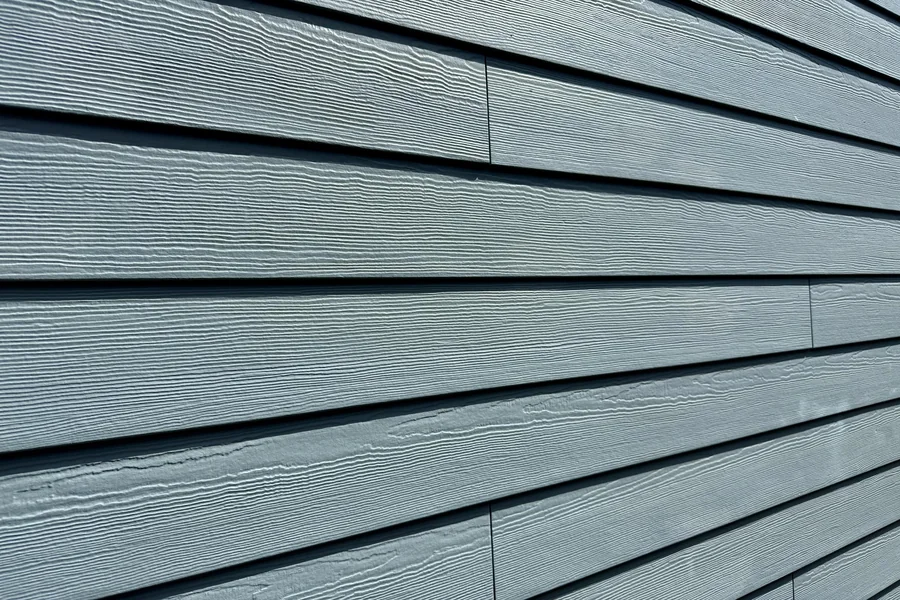
Fiber cement siding blends Portland cement, cellulose fibre, sand, and water into a dense board that behaves less like a coating and more like a structural skin. The cement supplies compressive strength while the fibre carries tension across each panel, so a hard knock spreads out rather than punching through. Fixed over a solid, non-compressible backing, the material resists the flex that opens cracks in thinner finishes.
How the Wall Manages Moisture and Pests
Water is the quiet destroyer of any exterior, so the assembly answers it in layers, each with a defined job:
- Sealed tape at the door and window edges that closes off the first entry points
- Regular, reverse, and side flashings that route meltwater down and away
- Two paper barriers that back up the flashings as vapour control
- A reinforced base coat and topcoat that shed surface water
Because the board offers no food value and no soft foam core, woodpeckers and insects find nothing to excavate, a failure point that plagues foam-backed walls every spring.
Cement Board and Stucco Compared: Installation and Joint Detailing
The gap between a wall that lasts thirty years and one that fails in five is rarely the material by itself. More often it is the detailing underneath, and the joint layout that most guides skip past without a word. Following that sequence, from the first strip of tape to the last coat, shows why the two systems age so differently.
The Layered Assembly, From Flashing to Finish
A panel wall goes up in stages rather than a single pass. Tape seals the openings, flashings route water, and paired paper barriers stand behind them. The boards then fix to the substrate, spray foam fills the gaps for stability, and mesh-reinforced base coat locks the joints before the acrylic layer colours the surface.
Here is how the two systems line up on the details that decide lifespan.
| Detail | Cement Board System | Traditional Stucco |
| Substrate | Rigid, non-compressible panel | Thin coat on lath |
| Impact resistance | High, absorbs and returns to plane | Lower, chips and spider-cracks |
| Pest resistance | No soft core to excavate | Vulnerable at foam-backed walls |
| Joint control | Engineered expansion joints | Fewer designed movement points |
Read the table top to bottom and one pattern holds, since the rigid system engineers for movement where the older finish leans on its topcoat to cope.
The Joint Layout Most Guides Miss
The reality is that most ranking articles on this subject never mention joint spacing, and that silence tracks straight to real failures across the region. Each rigid board expands and contracts through the daily temperature swing, so without designed break points the stress concentrates and cracks the surface. A correct assembly plans for that movement:
- Expansion joints at panel transitions to absorb seasonal shift
- Plaster stops at terminations for a clean, controlled edge
- Mesh-embedded base coat over each joint to spread tension before it cracks
- Foam-filled gaps that let panels move without loading their neighbours
- Flashing coordinated with joint lines so movement never opens a water path
Pro Tip: Ask any installer to show you the planned expansion-joint layout before work begins. A wall detailed for movement is the single strongest predictor of a crack-free finish.
By contrast, a stucco field carries fewer planned movement points, which is why its cracks so often follow the freeze-thaw line instead of a designed joint.
Long-Term Upkeep and Lifecycle of Panel Cladding
A cladding choice is really a fifty-year maintenance decision made once, and what the wall asks of you over those decades is where a rigid system separates itself from a troweled one. The upkeep stays light, though it never drops to nothing, and the payoff shows up in the repairs you never have to make.
Inspection and Cleaning Intervals
A twice-yearly walk-around catches small issues before weather turns them into structural problems, and the routine takes little time:
- Inspect flashings and joint lines each spring and autumn for opened seams
- Rinse the surface with a garden hose to clear dust, pollen, and grime
- Check the caulking at doors and windows, where seals age fastest
- Clear vegetation and downspout splash-back from the base of the wall
Catching a lifted flashing edge in spring costs minutes, while missing it until meltwater tracks behind a board costs a great deal more.
Recoating and Repair Expectations
The finish carries its colour in the coat rather than a surface paint film, so it holds tone for years longer than a painted skin. When a refresh comes due, a fresh coat renews the wall without a full strip-down. Repairs stay local as well, since a damaged section lifts out and a new one keys into the existing joints, so a single hail hit never means re-cladding a whole elevation.
Why the Lifetime Math Favours Rigid Panels
The purchase price tells only part of the story, and the years afterward tell the rest. Fewer crack repairs, longer gaps between recoats, and localized fixes push the cost per year below what a crack-prone surface demands over the same span. A wall that keeps its finish through decades of storms is the quiet return on the higher upfront spend, and that steadier math is what settles most cement board vs stucco decisions.